SaaS to Space
Written By
/
Scott Stanford
Date
/
October 1, 2026
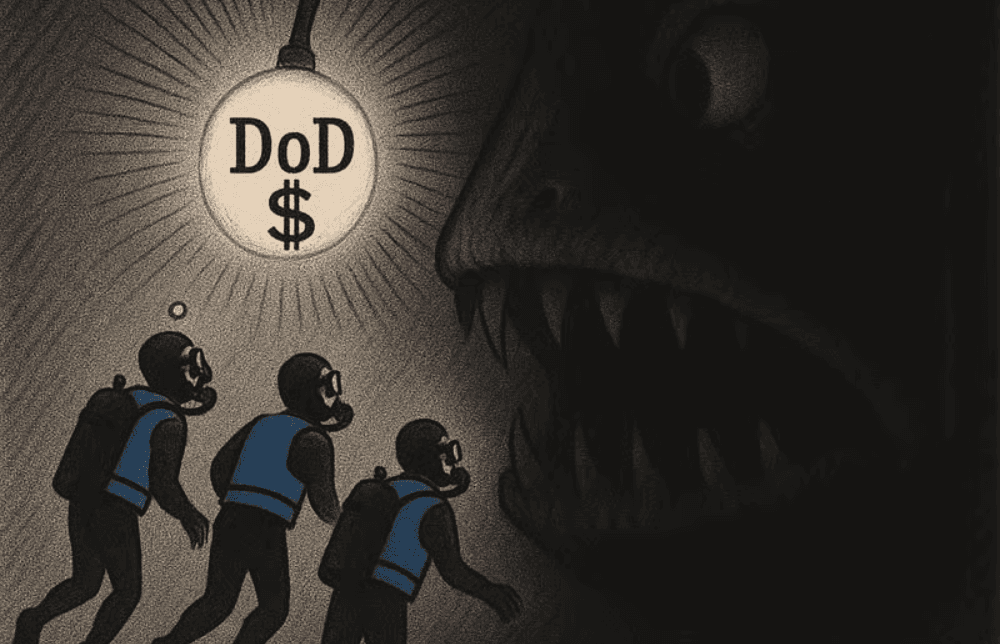
The VC herd is shifting course from once-safe, now-strained SaaS to Aerospace & Defense, an alluring prospect that plays by different rules. SaaS isn’t the predictable play it once was. AI is rewriting the playbook: erasing moats and shifting buyer needs, eroding the predictability that made SaaS so attractive.
The secret SaaS sauce wasn’t magic, just choreography: product, fundraising, and traction timelines that neatly lined up. Easy to take for granted.
The SaaS timelines are predictably in sync.
→ Product development moves quickly, and you have control. No physics, no hardware.
→ Fundraising is a well-oiled machine. Do X, and you got Y. Deep pools of investors who know the playbook.
→ Commercial traction is straightforward. For years, if you understood what your customer needed and built it, they bought.
A&D is different. The timelines don’t cooperate.
→ Product is harder. In SaaS, QA is a bug report. In A&D, QA means pummeling hardware in vacuum chambers, at hypersonic speeds, on vibration tables, at extreme temperatures.
→ Fundraising is less predictable. Fewer seasoned investors, shifting milestones, heavy upfront capex and R&D, dependence on grants.
→ Commercial traction is murky: buyer cycles are political, slow, and opaque. SBIRs and STRATFIs help, but often create false positives.
This doesn’t make A&D less attractive. But, it does make it different.
The excitement is real: DIU’s FY 2024 appropriation was nearly $1B, and since 2016, it has awarded $5.5B in contract ceilings to commercial companies, many of them startups. The Big Beautiful Bill added $156B to DoD’s $831B FY 2025 budget, bringing total defense resources close to $1T.
In A&D, timelines rarely align. Investors need a playbook that assumes gaps, delays, and unpredictable orders.
Success will go to those who underwrite to that reality.