Time Tracking & The State of Work
Written By
/
Scott Stanford
Date
/
November 1, 2026
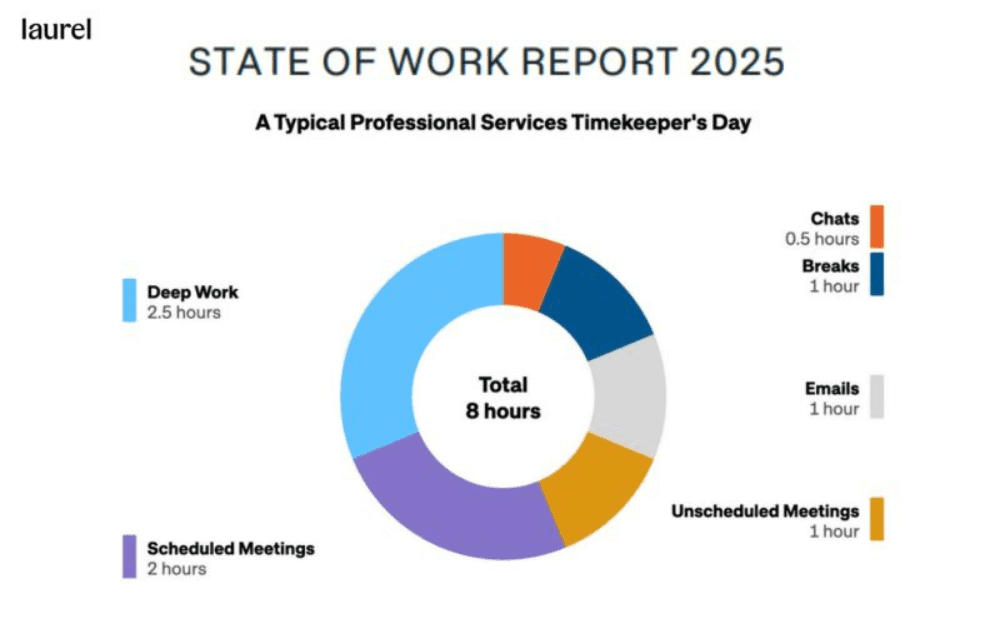
When I was an Analyst at Goldman Sachs I worked countless hours and sleepless nights. Today’s “Protected Saturday” policies would have been met with a scoff.
My bosses had no clue how I was spending my time. Frankly, neither did I.
We had to fill out high-level timesheets – a vague compliance checkbox everyone completed half-heartedly…
So I built my own in Excel. An hour-by-hour granular breakdown of how I was spending time. The pie charts and time series data gave me a handle on exactly where I created value (or not) and a way to communicate it upward.
Today I no longer need that kind of self-auditing (though I’m sure some would beg to differ), but the insight remains: you can’t optimize what you don’t quantify.
One of Laurel’s professional services clients discovered their senior project leaders were spending 14% of their time formatting PowerPoints. You don’t find that in a timesheet.
If British Petroleum uncovered a 1% oil-refinement gain, it’d transform their earnings. In professional services, massive inefficiencies pass unnoticed. So much of supply chains is human – time, attention, judgment – yet we still manage it with 1990s tools at best.
Laurel’s shared data highlights just a glimpse of the possible. Their AI system can turn time into structured, observable, and analyzable data: an unprecedented enterprise intelligence unlock.
From 2,000+ professionals across law and accounting, their latest report found:
→ 30% of all work time, roughly 3 hours a day, goes unrecorded, distorting revenue and capacity planning.
→ Professionals get just 15 minutes of uninterrupted focus during the day.
→ Firms adopting AI time solutions recover an average of 28 minutes of missed billable time, that’s $37,000 annually per professional (!).
Hard supply chains are engineered, refined, simulated, and stress-tested to the inch and the second. [There are entire expert organizations like Kearney that specialize in supply chain analysis and optimization.] However, understanding and optimizing knowledge work is still largely guesswork disguised as process.
To address the other 50% of the economy, we need to do what no time tracking, consultancy, or BI dashboard has done: accurately map, quantify, and analyze the physics of time and work.
Check out the full report → https://lnkd.in/gSFqbBHf